TIIDWI Article No. 9 By Oduor Kevin, CPO Stowelink Foundation
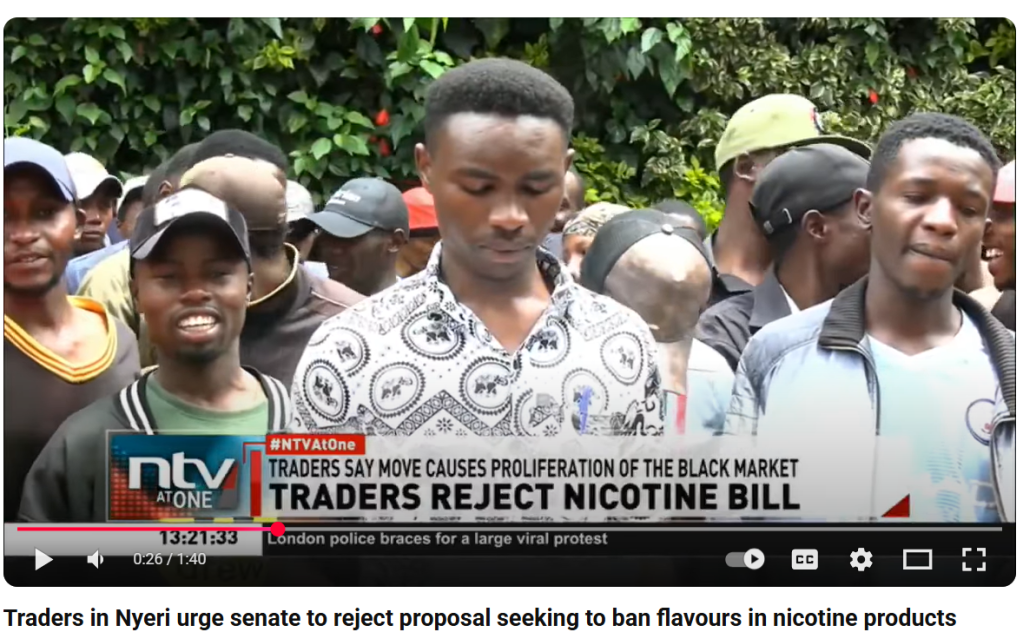
On September 10th, 2025, one of the leading TV stations in Kenya, NTV, aired a segment featuring a group of traders in Nyeri urging the Senate to reject a key provision in the Tobacco Control (Amendment) Bill, 2024. In their argument, they claim that imposing a ban on flavoured nicotine products including vapes and pouches would result in devastating impact including proliferation of illicit trade and interference with livelihoods of small traders. This reaction, while appearing to be grassroot, bears the unmistakable footprints of the tobacco industry’s interference playbook. Under the Tobacco Industry Interference Digital Watch Initiative (TIIDWI), we have been tracking, exposing, countering and documenting cases such as these. This marks our ninth article in the series, and once again, the tactics are familiar: mobilize proxies, manufacture public dissent, and derail progressive legislation.
Background: What the Tobacco Control (Amendment) Bill, 2024 Seeks to Achieve
The Bill currently before the Senate proposes to strengthen Kenya’s tobacco control framework by:
- Prohibiting flavoured additives in nicotine products (Section 14(j)(f)), which are known to attract minors.
- Mandating graphic health warnings to enhance public awareness of health risks.
- Closing regulatory loopholes exploited by emerging nicotine products like pouches and e-cigarettes.
The explanatory note accompanying the Bill clearly states its intent is to protect minors by making nicotine products less appealing through the prohibition of sweet flavours (Parliament of Kenya, 2024).
This is a public health imperative. Flavored nicotine products are a gateway for youth addiction, as documented by the World Health Organization and numerous peer-reviewed studies (Gades et al., 2022; WHO, 2025)
Attempts to Derail the Bill: A Pattern of Interference
This is not the first attempt to derail the Tobacco Control (Amendment) Bill, 2024. In our TIIDWI Article No. 5, we exposed how the Campaign for Safer Alternatives (CASA)—an industry-funded front group—pressured the Senate to reopen public hearings, citing the need for “fresh input” from new members. This was a thinly veiled delay tactic.
Even the Senate itself raised concerns about whether public participation had been adequately conducted, especially regarding graphic health warnings. We addressed this in TIIDWI Article No. 8, highlighting how such procedural challenges are often weaponized by the industry to stall reform.
Now, the Nyeri traders have entered the scene—yet another proxy in this orchestrated resistance (and predictably traders in other towns will be weaponized too by the industry).
Analysis: Dissecting the Nyeri Traders’ Claims
1. Claim: Banning Flavours Will Fuel Illicit Trade
This argument is not new. It’s a recycled talking point used globally by tobacco lobbyists. However, evidence from countries that have implemented flavour bans shows no significant surge in black market activity. A study by Kyriakos et al., 2023 in Netherlands concluded:
“There was no increase in illicit purchasing or of smuggling outside the EU among menthol and non-menthol smokers in the Netherlands 1 year after the EU menthol cigarette ban. Use of flavour accessories and non-menthol replacement brands best explain post-ban menthol use, suggesting the need to ban accessories and ensure industry compliance.”
In fact, regulation often reduces illicit trade by clarifying enforcement boundaries and empowering authorities to act decisively. The real threat to public health is unregulated, flavoured nicotine products, which are aggressively marketed to youth.
The industry often exaggerates illicit trade to scare policymakers into maintaining weak regulations. In fact, a 2022 World Customs Organization report documented that industry-linked supply chains are often the very source of illicit products.
2. Claim: Economic Harm to Traders
Claims by the tobacco industry that flavour bans will devastate small businesses are not supported by empirical evidence. In fact, comprehensive studies from jurisdictions like Massachusetts, New York, and Rhode Island—where flavoured tobacco products have been banned—show that such policies did not lead to significant reductions in the number of convenience stores, tobacco outlets, or employee wages (Tauras & Chaloupka, 2023). On the contrary, data from the U.S. reveal that even as cigarette sales declined, the number of convenience stores and their overall revenues increased, with food services contributing far more to profits than tobacco products. Cigarettes now represent a shrinking share of retail income, and their removal from shelves has not crippled businesses. These findings debunk the scare tactics often deployed by the tobacco industry, which exaggerates economic harm to resist regulation and protect its profit margins. (Tauras & Chaloupka, 2023).
The economic argument by these young people is emotionally compelling but analytically weak. The composition of the Nyeri group—mostly young people—raises questions. Is it plausible that such a large number of youth are solely dependent on selling nicotine products? This demographic skew suggests mobilization, not organic representation. These individuals appear to have been handed a script, not a platform. Where are the older traders? Where is the diversity of voices?
3. The Industry Behind the Curtain
One thing must be clear: the tobacco industry has a long history of using front groups, economic arguments, and procedural delays to obstruct regulation. What we’re witnessing in Nyeri is not a spontaneous uprising—it’s a strategic deployment of youth voices to sanitize industry messaging.
Across Africa, the tobacco industry has repeatedly mobilized small traders and tobacco farmers as proxies to oppose public health legislation, framing regulatory efforts as threats to livelihoods. This tactic— also known as the “third party technique”—is part of a broader interference strategy where the industry builds alliances with front groups to present its case indirectly, making it appear as though resistance is grassroots when it is in fact corporate-driven. These efforts are designed to delay, dilute, or derail tobacco control policies, exploiting economic anxieties to mask the industry’s vested interests.
The goal is simple: preserve profits by keeping flavoured nicotine products on the market, regardless of the public health cost.
A Plea to Young People: Know Who’s Using You
To the youth involved in this campaign: you are being used.The tobacco industry does not care about your livelihood, your health, or your future. It sees you as a tool to protect its bottom line. By opposing this Bill, you are not defending your community—you are defending an industry that profits from addiction and disease.
We urge you to educate yourselves, ask critical questions, and refuse to be pawns in a game that has devastating consequences.
References
Gades, M. S., Alcheva, A., Riegelman, A. L., & Hatsukami, D. K. (2022). The role of nicotine and flavor in the abuse potential and appeal of electronic cigarettes for adult current and former cigarette and electronic cigarette users: A systematic review. Nicotine & Tobacco Research, 24(9). https://doi.org/10.1093/ntr/ntac073
Kyriakos, C. N., Driezen, P., Fong, G. T., Chung-Hall, J., Hyland, A., Cloé Geboers, Craig, L. V., Willemsen, M. C., & Filippidis, F. T. (2023). Illicit purchasing and use of flavour accessories after the European Union menthol cigarette ban: findings from the 2020–21 ITC Netherlands Surveys. European Journal of Public Health, 33(4), 619–626. https://doi.org/10.1093/eurpub/ckad049
Parliament of Kenya. (2024). THE TOBACCO CONTROL (AMENDMENT) BILL, 2024 (SENATE BILLS NO. 35 OF 2024). https://parliament.go.ke/sites/default/files/2024-08/Bill%20Digest%20-%20Tobacco%20Control%20(Amendment)%20Bill,%202024.pdf
Tauras, J., & Chaloupka, F. (2023). The Economic Effects of Cigarette Sales and Flavor Bans on Tobacco Retail Businesses. https://www.economicsforhealth.org/files/research/865/final-report-cigarette-sales-flavor-bans-and-business-05.23.23-md.pdf
WHO. (2025, May 30). Sweet flavours and bright colours lure youth into nicotine addiction. Who.int; World Health Organization: WHO. https://www.who.int/europe/news-room/feature-stories/item/sweet-flavours-and-bright-colours-lure-youth-into-nicotine-addiction World Customs Organization. (2022). ENFORCEMENT AND COMPLIANCE Illicit Trade Report 2022. https://www.wcoomd.org/-/media/wco/public/global/pdf/topics/enforcement-and-compliance/activities-and-programmes/illicit-trade-report/itr_2022_en.pdf?db=web
 ODUOR KEVIN