
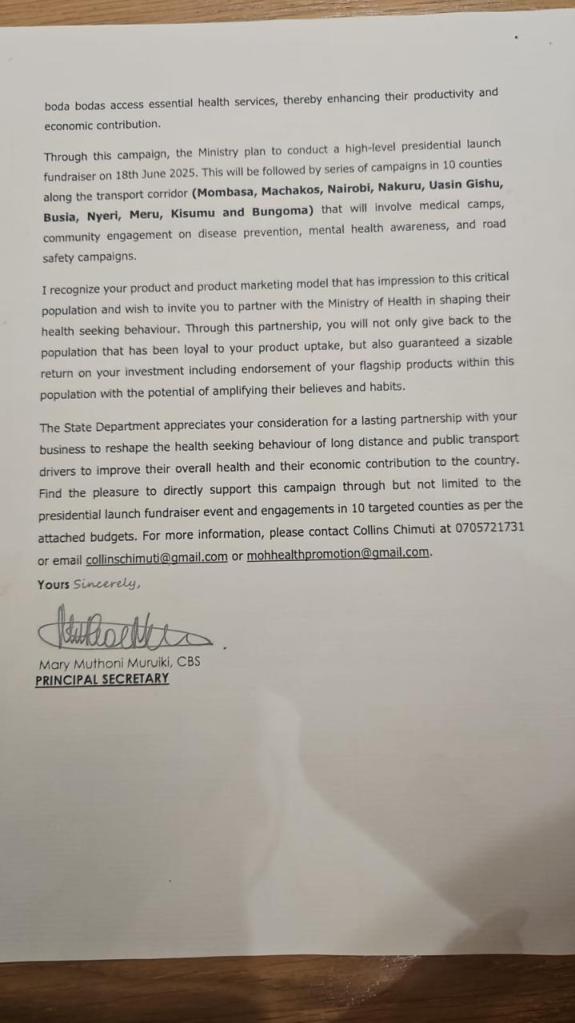
Today is World No Tobacco Day 2025. Tobacco control advocates are reeling from what could be one of the most disheartening developments in Kenya’s public health space. A letter—allegedly originating from the Ministry of Health’s State Department for Public Health and Professional Standards—invites British American Tobacco (BAT) to partner in health promotion campaigns targeting long-distance and public transport drivers.
Yes, you read that right.
In the letter dated 7th May 2025 and addressed to BAT Kenya Managing Director Crispin Achola, the Ministry (or someone impersonating it) writes:
“I recognize your product and product marketing model that has impression to this critical population and wish to invite you to partner with the Ministry of Health in shaping their health seeking behavior. Through this partnership, you will not only give back to the population that has been loyal to your product uptake, but also guaranteed a sizable return on your investment including endorsement of your flagship products within this population with the potential of amplifying their believes and habit.”
To say that this is shocking would be an understatement. It reads like a marketing pitch, not from a corporation—but from a public institution entrusted with the health of the nation.

Greenwashing and Violating Global Norms
This alleged invitation gives BAT an open license to greenwash its image: to portray itself as a “public health partner” while pushing products that are directly responsible for addiction, disease, and death. It dangerously normalizes an industry that the WHO Framework Convention on Tobacco Control (FCTC) rightly defines as incompatible with public health.
Specifically, Article 5.3 of the WHO FCTC states that:
“In setting and implementing their public health policies with respect to tobacco control, Parties shall act to protect these policies from commercial and other vested interests of the tobacco industry in accordance with national law.”
Kenya’s own Tobacco Control Act (2007) and Tobacco Control Regulations (2014) reinforce this directive. The law prohibits partnerships with the tobacco industry and any form of endorsement or promotion of tobacco or nicotine products by public officials. The guidelines explicitly instruct ministries and public servants to limit interaction with the industry to what is strictly necessary for regulation, and even then, such interactions must be transparent.
When I First Saw the Letter…
Like many advocates, I initially dismissed the letter as fake—perhaps BAT’s own trick to confuse or demoralize the tobacco control community. Surely, I thought, no one at the Ministry of Health could pen such an outrageous request.
This disbelief stemmed not just from my professional skepticism but from personal admiration. In fact, if you check my LinkedIn profile photo, you’ll see me standing proudly with the very Principal Secretary who signed the letter—during the Quality Healthcare Kenya Awards where I was honored with the Young Innovators Award. This is someone I deeply respect.
I even asked fellow public health advocates in one of my groups to verify the authenticity of the letter before pointing fingers at the PS or the Ministry as a whole. While I still cannot confirm whether the PS authored the letter herself—or whether someone misused her electronic signature—it is now confirmed from multiple reliable sources that this letter did originate from the Ministry of Health.
Silence Speaks Volumes
The Ministry has neither denied nor clarified the origin of this letter. This silence is concerning. And while it’s possible that the letter is the result of internal sabotage or a gross misuse of authority, the implications are the same: Kenya’s Ministry of Health is either being infiltrated or complicit in actions that violate our national and international obligations on tobacco control.
It is worth noting that this alleged partnership is tied to a road safety campaign targeting transport drivers across 10 counties (Mombasa, Nairobi, Machakos, Nakuru, Uasin Gishu, Nyeri, Meru, Kisumu, and Bungoma), to be launched by the President himself on 18th June 2025. This puts the tobacco industry at the center of a public campaign—exactly what the FCTC and Kenyan law were designed to prevent.
World No Tobacco Day Must Be a Moment of Reckoning
As we gather in Eldoret and Kaloleni to mark World No Tobacco Day, we must ask ourselves: Are we serious about tobacco control? Are we truly implementing FCTC Article 5.3, or are we allowing dangerous loopholes to be exploited?
Let me be clear: this article is not an attack on the entire Ministry of Health. I know firsthand that there are many within MOH who are passionate and committed to advancing tobacco control in Kenya. But this is a call-out—a demand for accountability and transparency. We must call out those within our public institutions who work in cahoots with the tobacco industry, knowingly or otherwise, and remind them: public health is not for sale.
#WCTC2025 #WNTD2025KE #TIIDWI2025
 ODUOR KEVIN