
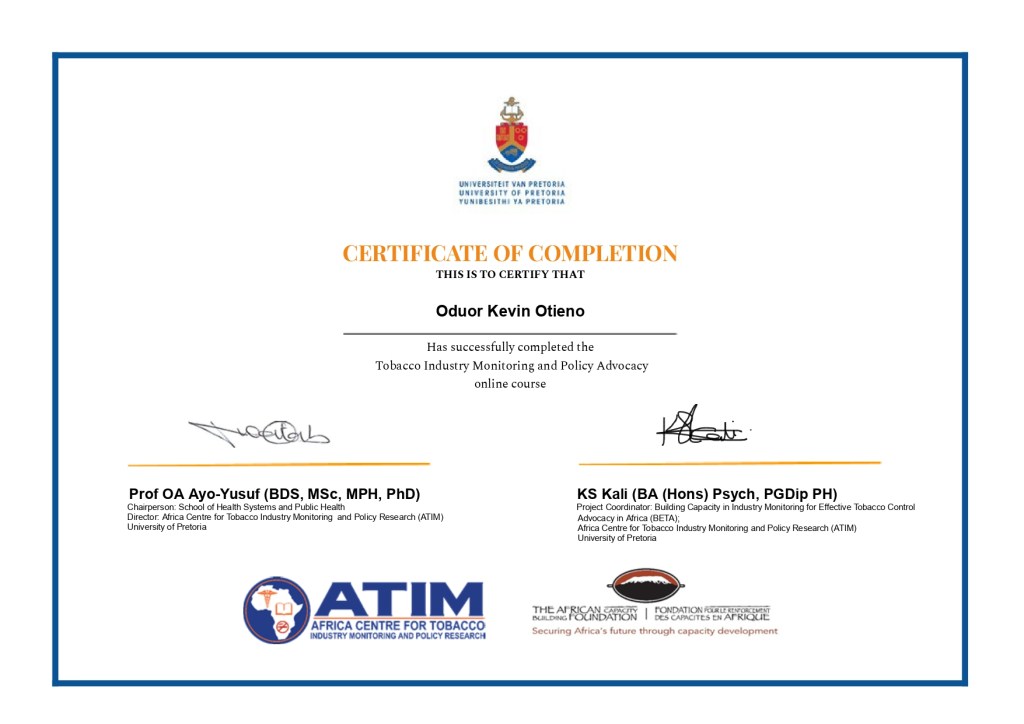
I am thrilled to share that I have successfully completed the Tobacco Industry Monitoring and Policy Advocacy course offered by the Africa Centre for Tobacco Industry Monitoring and Policy Research (ATIM). This was a transformative learning experience that deepened my understanding of tobacco control policies, industry interference, taxation, litigation, and the broader economics of tobacco.
I am immensely grateful to ATIM for the opportunity to undertake this course. The knowledge I have gained will be instrumental in my ongoing work in public health advocacy, particularly in addressing the challenges of tobacco use and its intersection with non-communicable diseases (NCDs). In this blog, I will highlight key lessons from the course and how I plan to apply them in my work.
Tobacco Control Policies and Programs in Africa
I learned that tobacco use remains the leading preventable cause of NCDs, with over 77 million people in Africa currently smoking. The WHO Framework Convention on Tobacco Control (WHO FCTC) provides a foundation for global efforts, but Africa still lags in implementation. With rising tobacco use among young people, urgent policy interventions are needed, including higher taxation, advertising bans, health warnings, and smoke-free laws.
How I will apply this: I will continue advocating for stronger domestication and enforcement of WHO FCTC policies in Kenya and across Africa, ensuring that youth are protected from early tobacco initiation.
The Tobacco Industry in Africa
A key takeaway from this module was how the tobacco industry targets Africa as an expansion market due to lower smoking prevalence compared to other regions. Major tobacco manufacturing hubs are in Egypt, Nigeria, and South Africa, with industries also emerging in state-owned companies. The industry pushes novel tobacco products, such as heated tobacco and e-cigarettes, as “harm reduction” tools, despite evidence showing their risks.
How I will apply this: I will work to counter industry narratives that portray novel tobacco products as “safe alternatives” by ensuring evidence-based communication in my advocacy work.
Countering Tobacco Industry Interference
One of the most alarming lessons was how the tobacco industry actively interferes with public health policies. The industry uses lobbying, litigation, corporate social responsibility (CSR) strategies, front groups, and misinformation to delay or weaken legislation. Article 5.3 of WHO FCTC explicitly warns against conflicts of interest between governments and the tobacco industry.
How I will apply this: I will contribute to tobacco industry monitoring, documenting cases of interference, and supporting efforts to limit government-industry interactions in Kenya.
The Economics of Tobacco Control
The course reinforced that tobacco taxation is the most effective tobacco control measure, yet remains underutilized in Africa. Raising taxes increases prices, leading to lower consumption—especially among youth and low-income populations. The module also highlighted the economic exploitation of tobacco farmers, where smallholder farmers struggle to make a sustainable living, often suffering from green tobacco sickness and labor abuses.
How I will apply this: I will strengthen advocacy for higher tobacco taxes and policies that support alternative livelihoods for tobacco farmers, ensuring they transition to more sustainable crops.
Tobacco and the Law
This module explored litigation as a tool for holding the tobacco industry accountable. Historically, legal battles have forced the industry to reveal internal documents exposing deceptive practices, as seen in the U.S. Master Settlement Agreement. However, the industry also weaponizes legal systems to challenge regulations, causing regulatory delays—as witnessed in Kenya, where it took 13 years for the Tobacco Control Act to be fully implemented due to industry litigation.
How I will apply this: I will support efforts to educate policymakers and legal professionals on the importance of legal frameworks in tobacco control and the dangers of industry lawsuits.
Understanding the Policy Process
The policy-making process involves agenda setting, policy formulation, decision-making, implementation, and evaluation. Tobacco control policies require strong political will and multi-sectoral collaboration to succeed. Evidence shows that tobacco use imposes greater economic costs than the revenue generated from tobacco taxes.
How I will apply this: I will advocate for evidence-based policymaking, ensuring that public health is prioritized over tobacco industry profits in decision-making spaces.
Introduction to Evidence-Based Advocacy
This module emphasized strategic advocacy—using data, storytelling, coalition-building, and media engagement to push for tobacco control policies.
How I will apply this: I will work with like-minded advocates to amplify tobacco control messages through digital advocacy, policy briefs, and public awareness campaigns.
Tobacco Industry Interference in Africa
This module focused on monitoring and exposing tobacco industry interference. Research is critical in identifying tactics such as co-opting policymakers, using misinformation, and funding front groups to derail public health efforts.
How I will apply this: I will support efforts to track and report tobacco industry interference in Kenya and collaborate with regional networks to strengthen watchdog initiatives.
Practical Approaches to Monitoring
This module provided tools and methodologies for systematically monitoring tobacco industry activities, including media tracking, policy analysis, and stakeholder mapping.
How I will apply this: I will contribute to real-time monitoring and documentation of tobacco industry actions that undermine public health policies.
Tobacco Taxation and Illicit Trade
This module highlighted tobacco taxation as the most effective yet least implemented strategy in the MPOWER package, debunking the myth that tax increases automatically lead to illicit trade. Instead, illicit trade is driven by smoker demand, weak governance, and supply from legal and illegal manufacturers. It also covered Kenya’s Track and Trace system as a solution.
How I will apply this: I will apply this knowledge by advocating for higher tobacco taxes while countering misinformation from the tobacco industry on illicit trade.
Practical Approaches to Monitoring and Responding to the Tobacco Industry
This module emphasized the need to systematically track and expose tobacco industry tactics, including lobbying, media manipulation, misleading CSR initiatives, and industry-funded research. Given the industry’s history of evading regulations, continuous monitoring is crucial.
How I will apply this: I will apply this by actively identifying and exposing industry interference, ensuring that policymakers and the public are aware of these deceptive strategies.
Creating a Tobacco Monitoring Model
This module provided a structured approach to tobacco industry monitoring through data collection, analysis, and advocacy. A strong monitoring framework ensures transparency and strengthens tobacco control policies.
How I will apply this: I will apply this by contributing to a data-driven monitoring system that informs policy actions and strengthens the fight against tobacco industry interference in public health.
Final Thoughts
Completing this course has been an empowering experience, equipping me with deeper knowledge, stronger advocacy tools, and a renewed commitment to fighting tobacco-related harms.
I am grateful to ATIM for selecting me for this program, and I look forward to applying these insights to strengthen tobacco control efforts in Kenya and beyond.
The fight against tobacco industry interference is far from over, but with evidence, policy, and advocacy, we can protect the next generation from the harms of tobacco.
 ODUOR KEVIN