
Perhaps, the best way to look at anxiety is to reflect on the Covid-19 pandemic. While the pandemic is no longer a Public Health Emergency of International Concern (PHEIC), following its lifting on 5th May 2023, many can still remember how it caused unimaginable anxiety and panic attacks, Many felt the strain on their mental health, worried about getting laid off or having to continue to work amidst the ravaging pandemics much to the risk of contracting COVID-19. The emergence of the pandemic perhaps brought these two mental health conditions to the fore, with global and local discussions dominated by how to cope with them and their ramifications if not checked.
In furtherance to the global, regional, and local discussion around mental health, I was invited to talk about anxiety and panic attacks in a Twitter Space hosted by PsychX, a mental wellness platform.
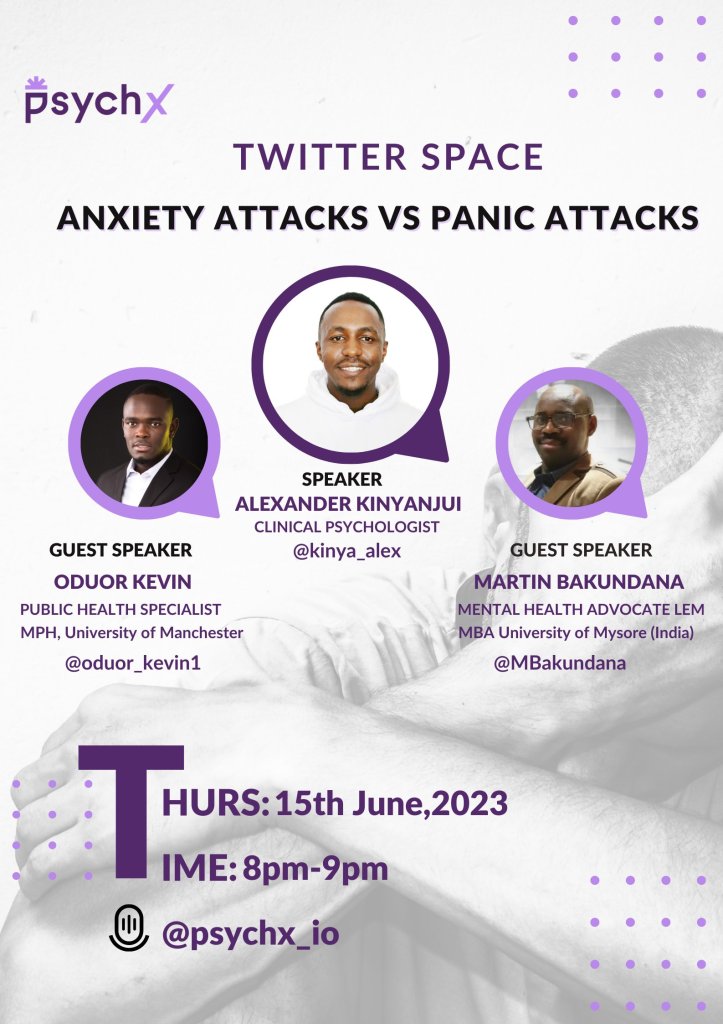
I weighed in on the discussion, mentioning that anxiety and panic attacks are important public health issues requiring robust responses at individual, local, national, regional, and even the global level. Together with my co-speaker, we ensured the discussion was illuminating and stimulating, effectively explaining the similarities and differences between anxiety and panic attacks.
It is noteworthy that anxiety and panic attacks have striking similarities but also differ fundamentally. Panic attacks are often more intense and can occur with or without a trigger, while anxiety attacks are a response to a perceived threat. Anxiety attacks are prospective while panic attacks can be both prospective and retrospective. Panic attacks can occur as a result of past trauma while anxiety is as a result of “anticipated danger/threat.
Anxiety and panic attacks are mental health issues that can impact our dietary and sleep patterns. Binge eating is one of the classical examples of eating disorders which can lead to unhealthy weight, increasing our vulnerability to NCDs. Moreover, generalized anxiety is associated with many other poor health outcomes, besides NCDs. These connections suggest how supporting mental health is critical, especially in preventing challenges like chronic diseases.
In finishing, we elucidated some of the coping strategies that individuals can leverage to effectively manage anxiety and panic attacks. They include;
- Relaxation techniques such as deep-breathing exercises and taking a long bath among others.
- Regular physical exercise to release the feel-good hormone to stimulate positive emotions.
- Maintain a support network by talking to friends.
- Manage triggers that can lead to stress such as avoiding completing tasks towards the deadline.
 ODUOR KEVIN